Virtual Tour

Our coffee farm covers forty-seven acres, nearly all of it forest sheltering coffee trees beneath a green canopy. On the south side stand the buildings — a large courtyard enclosed by adobe walls, holding the tiled drying patio and the farmhouse itself.

The farmhouse was damaged by the two earthquakes that devastated El Salvador on 13 January and 13 February 2001. The rebuilding that followed was done with every effort to preserve as much as possible of the hundred-year-old structure.

The courtyard

Sheltered in one corner of the courtyard is a nursery where small coffee plants sprout from seed. They are used to replace older plants damaged in storms. Behind them stand some of the adobe farm buildings.

Finca Santa Rosa is a real working farm and, like all such farms, there is always a lot going on. We have to make optimum use of the space within the courtyard for all the tasks that keep the place running.
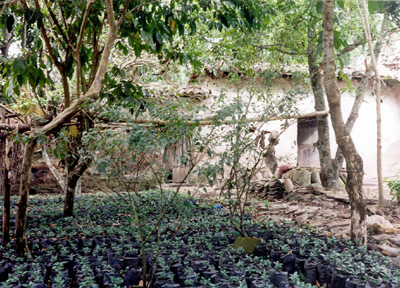
Rows of young plants in the farm courtyard, with trees and an adobe wall behind

The coconut tree

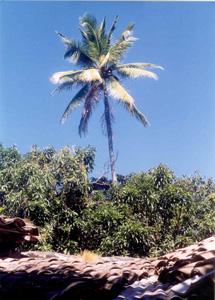
Look up from the patio and you will see the trees that surround the farm. Towering over them is one large coconut palm. A survivor of many storms, it also produces delicious fruit, which can only be gathered by professional foresters. These brave souls tie themselves to the trunk and climb all the way up. At the top they cut off the cocos and lower them to the ground on ropes. After a few hacks with a machete, everyone is soon enjoying the sweet water and mild flesh of the coconuts.

A tall coconut palm towering above the surrounding trees against a clear sky

Step outside the door

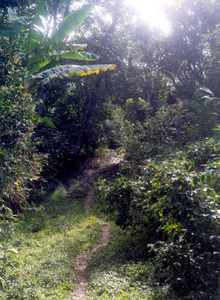
Step outside the door of the farm and this is what you see: a trail winding away into the jade expanse of the forest. This is a quiet world — all sound is muffled by the foliage, and only the songs of birds can be heard. The air is incredibly clean and fresh, the breath of the forest itself. Butterflies are everywhere, myriads of Heliconius and the occasional metallic blue Morpho. Around every corner there is a new vista, some new jewel of the natural world waiting to be found.

A narrow trail disappearing into dense green forest

El Amate

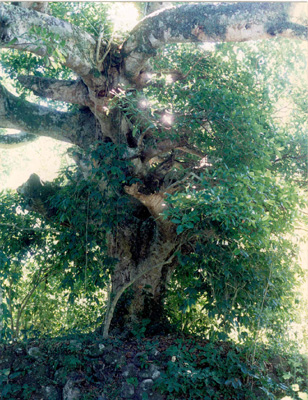
A short walk from the farm buildings stands “El Amate”, perhaps the most important tree on our farm. Amates are native to Central America and members of the fig family. This huge tree rises beside the main trail and spreads its gigantic limbs high into the canopy. It is home to a host of orchids, bromeliads, ferns and other plants. Admired by the local community as what an amate should be, it is indeed a spectacular sight.

El Amate, a massive fig tree with a gnarled trunk and wide spreading limbs

Planting

Planting is something that has to be done every year. We lose a few shade trees and many more coffee trees to storms and other accidents. New trees are grown in nurseries on the farm, and when the rainy season is under way it is time to plant them out.

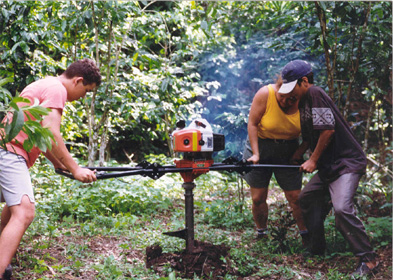
Holes have to be dug, and our motorized auger is a big help. It lets us plant many more trees per day than if the holes had to be dug by hand. Here Kenny, Rina and Alfonzo — left to right — are tackling a piece of heavy ground.

Three people working together with a motorized auger to dig planting holes in a clearing

Harvesting

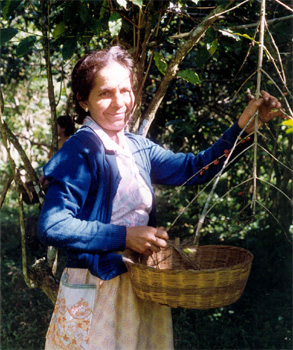
Harvesting coffee requires experience. It is important to pick only the ripe red cherries, and not to break branches or pull off the buds that will be next season’s flowers. Doña Luci, one of our neighbors, is well versed in coffee culture and knows exactly what she is doing.

Like all coffee cutters she wears a basket — a canasta — tied at the waist, which leaves both hands free to work the branches. When the basket fills it is emptied into a sack; when the sack fills it goes back to the farmhouse to be weighed and emptied onto the drying patio.

A woman in a blue jacket picking coffee, a round basket tied at her waist

The patio

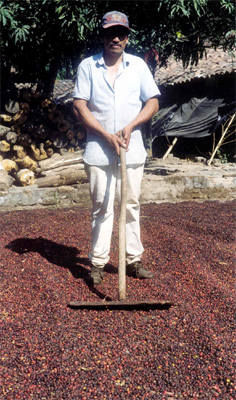
The patio is used to dry the coffee. It cannot be piled too high, and must be turned over at regular intervals to dry evenly. This is the essence of the natural process. Here German is working with newly picked cherries; it will take about ten days for them to dry properly.

As they dry their color changes from red to gray-brown, and the flesh of the fruit becomes a leathery husk that must later be peeled to release the beans. As the coffee dries it releases a sweet, musky scent. That sweetness is absorbed by the beans within their husks, and enhances their flavor.

A worker raking drying coffee across a wide reddish-brown tiled patio

The landscape

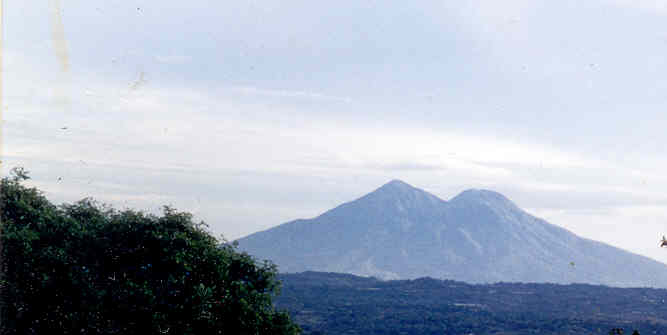
The landscape beyond our farm is dominated by the twin peaks of the extinct volcano of San Vicente, called Chinchontepec in the native language. The best view is from the hill called “Buenos Aires” — a good name, for the cooling breezes that can be felt there on a hot day.

From Buenos Aires you can also see the city of Ilobasco, and the hills of the remote, sparsely populated country that stretches north to the mountainous border with Honduras. Looking back down at the jade-colored forest that is our farm, we are always reminded of the heritage we are fortunate enough to be stewards of.

The twin peaks of the San Vicente volcano rising beyond wooded hills

More of our family

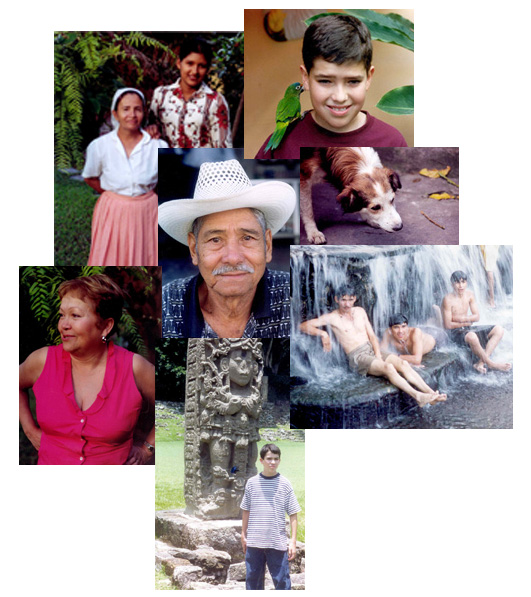
Meet some of the other members of our farm family. At the top left are Lidia and Evelyn. Next, with the small lora on his shoulder, is Mark. Tío Toño, our chief advisor, is below Mark, and to the right of him is the faithful Rocky. Below Rocky, Cheptio, Memito and Alonzo are enjoying an afternoon off at the springs in San Vicente. To the lower left is Doña Rina, the owner of Finca Santa Rosa. At the lower center is Chris, pictured on a visit to the Mayan city of Copán, a few hours drive away.

A collage of family snapshots showing members of the farm household and a dog

More about the farm

Read how the coffee is grown and processed, or follow the farm through a full year.

The farm The coffee year