The Coffee Year

The coffee year begins in April, when the rains break the long dry season, and ends the following March in the heat before they return. Here is what happens on the farm, month by month.

April

This month marks the beginning of the coffee year on Finca Santa Rosa. It is when the rains come after the long dry season. Everyone waits anxiously for the first storm, and there is enormous relief when it finally comes. A few days later the coffee trees burst into flower, filling the forest with a heady scent of jasmine — an overpowering experience that, once had, can never be forgotten. April also brings a new crop of mangos, and we have them in abundance.
A coffee branch densely covered in small white blossoms

May

By now the rains are frequent, usually taking the form of late afternoon downpours. When they begin everyone runs for cover and watches, mesmerized, from the corridor of the farm as the fury of the storm lashes the canopy trees. The streams are flowing again, alive with little fishes, freshwater crabs and a myriad of other small creatures.

The coffee trees have set their fruit now, and we try to gauge what the crop will be like. Our trees are Bourbon, the oldest variety in Latin America. Although most people agree they produce the best coffee, they are not always reliable — sometimes producing abundantly, at other times holding back their bounty. Loroco flowers come in May. Perhaps the most prized of all foods in El Salvador, their savory taste is a perfect complement for cheese. It must be experienced, because it cannot be described.

Young coffee seedlings sprouting among dry leaf litter on the forest floor

June

This is the month when the shade trees must be pruned. Coffee needs shade, but too much will restrict growth and production. It is a delicate balance, and our task is to carefully remove excess limbs without damaging the shade trees. Of course we take great care to save the orchids and other epiphytes from the branches we remove; they are taken to our plant rescue center. The wood is cut into firewood and stored in well-ordered cords at the edge of the courtyard. During June we harvest avocados. Their creamy flesh is always a favorite, and taken straight from the tree they are especially delicious.

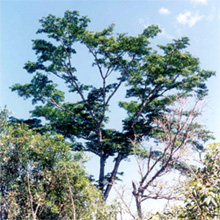
A large spreading shade tree standing above the coffee, against a blue sky

July

It is time to plant new trees. We have our own small nursery for coffee trees, and they are now big enough to be transplanted into the forest. The saplings replace trees damaged by storms, or by cows and horses that sometimes get into the farm. Storms take their toll of shade trees too, and they must be replaced as well. We keep a nursery of shade trees and try to grow only native Central American species, though we do include a few fruit trees from other parts of the world. One is the banana, and we have all kinds of varieties, from finger-length niños to robust plátanos. They produce all year round and are almost a staple of our diet.

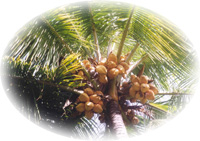
A cluster of ripening coconuts hanging among palm fronds

August

This is generally a quiet month for coffee cultivation, but it is the time of year when beans and maize are planted. These are the staple food crops of Central America, and we only need a couple of small fields to be self-sufficient. We also plant yucca (manioc) anywhere we think may be prone to soil erosion; this edible root holds the soil back and is another favorite food on the farm. In August the cochinitos can be harvested — small nut-shaped fruits with soft spines that grow on thin vines. They taste like cucumbers and are exciting to eat, because they literally explode in your mouth.

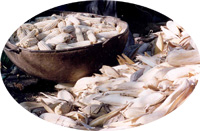
A wooden bowl heaped with pale husked maize cobs

September

All eyes are now on the state of the coffee crop. We scan the forest for any green coffee berries that are turning red. Coffee should not ripen for another month, and if it does it is a sign of the coffee borer weevil. Any red berries are picked and boiled to kill the little pests. It is also time to start clearing excessive undergrowth, because when the harvest starts the pickers will want clear access to the trees. Mistletoe, with its golden berries, is another enemy that can quickly smother a tree and eventually kill it; it too must be cleared away. Guavas are found all over the farm during this month, good eaten out of the hand or turned into desserts and preserves.

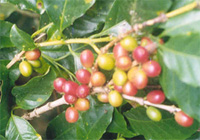
A coffee branch bearing a mix of green, yellow and red cherries

October

The first part of the harvest begins. Coffee berries — “cherries” in English, uvas (“grapes”) in Spanish — are close to the size, shape and color of cranberries, and grow in red clusters on the thin outer branches. Unlike many other crops they do not ripen all at once; they mature slowly over a period of three months or so. Only the reddest berries make quality coffee, and any one tree usually bears a mix of red, yellow and green. This is why coffee must be harvested by hand — to select only the ripest.

October brings sapotes, called mamey outside El Salvador. The rich orange flesh has the texture of an avocado but is much sweeter, and at the center is a stone that looks more like a polished ornament than a seed.

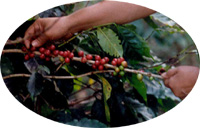
A hand reaching in to pick ripe red cherries from a coffee branch

November

This month is when the main harvest takes place. We have put out word that we need cortadoras — “coffee cutters”, as they are called in El Salvador. They arrive from the neighboring communities for what is a socially important occasion as well as an economically important one.

We take the coffee to our patio, where it is sorted and laid out to dry in the sun. This is the natural method. It is more manually intensive than the washed method, which involves crushing the cherries and fermenting them for several hours; but done properly, the natural method imparts a richer flavor as the sweetness of the cherry infuses the bean. At this time of year, if we are lucky, we find guisamperas. These strange triangular fruits grow on vines that wind around the coffee trees; the outer skin is scraped off and the interior used as a salad vegetable.

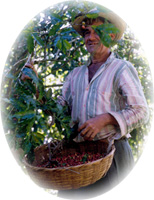
A coffee picker holding a wide basket of freshly picked cherries among the trees

December

By now the main part of the harvest is over and we can generally handle the rest ourselves. The coffee is bagged and stored away; later it will be peeled to release the green coffee from the husks that now protect it. A major task is repairing the fences after so much activity, and pruning back branches damaged during the harvest. As Christmas approaches everyone’s thoughts turn to the holidays, and the month ends with fireworks and festivities on New Year’s Eve. This is a good time to take advantage of the other vegetables we grow — one is the guisquil, also known as the chayote, which has many uses in stews, in soups, and in patties where it is mixed with cheese.

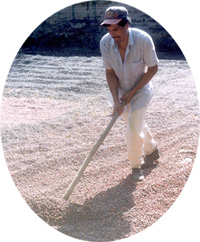
A man raking drying coffee into rows across the patio with a long wooden rake

January

There is still a little harvesting to be done, but it finally ends in the middle of this month. This is the time to attend to other tasks. Clearing away trees felled by storms is labor-intensive and difficult, sometimes needing a team of oxen to be brought in. Building work is required, and the adobe farm buildings usually need some kind of attention. The springs from which we draw our water have to be cleaned out, and it seems there is never enough time to attend to everything. Cashews ripen in January, and we use both the seed and the flesh of this strange-looking fruit.

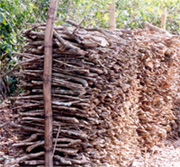
Firewood stacked in a neat cord between upright posts

February

Once more we turn our attention to pruning the coffee trees. It is now well into the dry season and very easy to recognize dead wood. We need to establish good air circulation around the trees and make sure they carry only healthy growth. Sometimes it is necessary to cut a tree right back to its main stem. This looks drastic, but soon small green shoots sprout up, and in a few years they develop into productive branches that yield coffee in abundance.

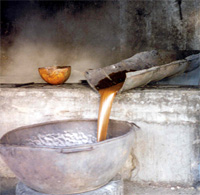
The great event of this time of year is the molienda — the production of sugar. Tío Toño runs these pre-dawn-to-late-night events on his farm a few kilometers away. They start with pressing the juice from sugar cane, which is collected into great metal pans. These rest on adobe fire houses that burn all day to evaporate the juice down to the point where pure cane sugar remains, and it is turned out into molds made from tree trunks split in half. The molienda is half festival, half workday, and one of the most popular events in the countryside.

Sugar cane juice running down a wooden trough into a large metal boiling pan

March

The peak of the dry season. By now the farm is looking less green than at any other time of year, and the heat makes everything seem tired and slow. It is a time of waiting, and is nearly always the month of Easter. Semana Santa — Holy Week — is the most important holiday in Latin America. The nearby town of Ilobasco holds Passion processions, and the streets are laid out with alfombras, pictures made on the tarmac with colored sawdust. After Easter Sunday it is all over, and back on the farm we wait for the turning of the season. Anxious eyes look to the heavens for clouds that will bring rain and start the cycle of the coffee year once more.

A pale farm dog asleep on the grass in the heat of the dry season

See the farm itself

Walk around Finca Santa Rosa, from the courtyard to the forest trail.

Take the virtual tour